
Honey Processing in Liberica Coffee
Flavor defects such as harsh bitterness, woody or decaying notes, wild character, or the heavy, overripe pungency sometimes associated with jackfruit-like Liberica are not fixed traits of the species itself. Rather, they are often the result of outdated farming and processing practices. The shift from traditional processing methods to more sophisticated, fermentation-controlled techniques, especially Honey processing has shown a remarkable ability to transform Liberica’s flavor profile. This method not only reduces negative flavor notes, but also unlocks layers of complex tropical fruit character, deep sweetness, and the rich body for which well-processed Liberica can be known.
I. The biological and physicochemical characteristics of Liberica in processing
To design an effective Honey processing protocol, it is first necessary to understand the anatomy and chemical composition of the Liberica bean in depth. These are the factors that fundamentally distinguish it from Arabica and Robusta and create its own unique technical challenges.
Morphology and Bean Structure
The biggest difference with Liberica lies in the size and shape of the bean, which directly affects machinery design and drying protocols.
-
Liberica beans are exceptionally large, with an average weight of around 0.26g per bean, noticeably larger than Arabica (0.19g) and Robusta (0.20g). Their shape is asymmetrical, often resembling a teardrop or almond with a distinctly hooked tip.
-
Liberica cherries have a very thick, tough outer skin, along with a much more abundant pulp and mucilage layer than Arabica. This creates a major challenge during depulping. Standard depulpers designed for Arabica often crack Liberica beans or fail to remove the skin cleanly because the beans are oversized and the fruit skin is so resilient.
-
Although Liberica has a thick outer protective layer, the green seed inside is actually more porous than high-grown Arabica. This porous structure is a double-edged sword. It allows water and heat to penetrate quickly during brewing, but during Honey processing it also means the bean can easily reabsorb moisture from the environment and pick up off-aromas if drying is prolonged under humid conditions.

Biochemical Composition: Sugar and Caffeine
Liberica’s internal chemistry is what determines its flavor potential when paired with the Honey method.
First is its sugar content. Liberica is often considered a naturally “sweet” coffee species because its cherries mature over a long cycle of 9 to 11 months compared with around 9 months for Robusta and 7 to 9 months for Arabica. This extended ripening period allows more time for nutrients and sugars to accumulate in both the bean and the mucilage. In Honey processing, those sugars are not washed away, as they are in fully washed coffee, but are instead retained, partially absorbed into the bean, and later contribute to caramelization and Maillard reactions during roasting. The result is deeper sweetness and a heavier body.
Second is caffeine content. Liberica has the lowest caffeine concentration among the three major commercial coffee species, at around 1.23g/100 g, compared with 1.61g for Arabica and 2.26g for Robusta. This helps explain why Liberica’s bitterness, when processed properly, is usually much softer than Robusta’s. The harsh bitterness found in lower-quality Liberica is often the result of over-roasting or poor processing that generates phenolic compounds, rather than being an inherent quality of the bean itself.
Finally, there are its antioxidant compounds. Liberica’s silver skin and fruit flesh contain relatively high levels of phenolics and flavonoids. During Honey processing, the extended contact between the silver skin, mucilage, and seed allows these compounds to interact with the bean, contributing either slight astringency if poorly controlled, or desirable complexity if handled correctly.


II. The science and classification of Honey processing in Liberica
Honey processing also referred to in some coffee-producing regions as semi-washed or pulped natural sits between Natural and Washed processing. For Liberica, it is often seen as the “golden key” to flavor balance. It reduces the risk of over-fermentation those overly funky, spoiled wine-like defects that are common in Natural Liberica because of the fruit’s unusually thick skin while preserving the sweetness and body that fully washed processing often strips away.
The term “Honey” does not mean actual honey is added. Instead, it comes from the tactile appearance of the sticky mucilage left on the parchment coffee during drying. Under the sun, this layer becomes thick, tacky, and glossy, resembling honey. Depending on how much mucilage is retained and how long the coffee is dried, oxidation and fermentation produce different visual styles Yellow, Red, and Black Honey each associated with a distinct sensory profile.
Yellow Honey 
This is the fastest-drying and least fermented style within the Honey family.
After depulping, around 25-50% of the mucilage is retained on the parchment coffee. In practice, the beans are often lightly rinsed or depulped under pressurized water to remove most of the mucilage, leaving only a thin layer behind.
The coffee is then dried under direct sunlight or in a well-ventilated greenhouse to maximize moisture loss. Bean mass temperature may briefly reach 45-50°C (113-122°F).
Drying typically takes around 4 to 8 days. Frequent turning is required every hour or every six hours, depending on the stage to ensure even drying.
In terms of flavor, Yellow Honey Liberica produces the cleanest cup and comes closest to the profile of washed Arabica. It highlights floral and citrus notes while minimizing the more intense jackfruit character. It is therefore a relatively safe option for producing high-quality commercial Liberica with lower mold risk.
Red Honey

This variation strikes a balance between clarity and richness, and it is widely favored in specialty Liberica processing.
In this style, around 50-75% of the mucilage is retained. The coffee is not washed after depulping.
The coffee is usually dried in partial shade such as under 50% shade netting or under morning sun and then covered at midday. The goal is to slow drying and extend aerobic fermentation on the raised beds, typically over 10 to 15 days.
This moderate oxidation turns the mucilage a rust-red color. In Liberica, the flavor moves toward caramel, molasses, and ripe fruit. Red Honey helps soften Liberica’s structure, transforming its sharper jackfruit character into something sweeter and rounder, more like ripe jackfruit or dried tropical fruit.
Black Honey (Mật ong Đen)

This is the most complex and highest-risk Honey style, but also the one capable of delivering the most distinctive flavor value. It is often reserved for competition lots or very carefully managed micro-lots.
With this method, nearly 100% of the mucilage is retained; only the outer fruit skin is removed.
The coffee is dried entirely in the shade or in temperature-controlled greenhouses. Moisture loss is intentionally very slow.
Drying may take anywhere from 15 to 30 days.
Because such high sugar content and moisture are maintained for a long period, the beans are extremely vulnerable to mold or undesirable fermentation, including excessive acetic acidity and vinegar-like off-notes. The coffee must be turned constantly sometimes every 30 minutes in the early days and water activity must be monitored very closely.
When successful, this method produces coffee with an exceptionally heavy body, deep sweetness reminiscent of dark chocolate and cream, and complex notes of wine and concentrated fruit preserves. In Liberica, Black Honey can completely mask woody defects and replace them with an explosion of fermented tropical fruit character.
Advanced Technique: Liberica Honey Mosto

A newer development in Liberica processing, particularly noted in Indonesia especially in Central Java and Puntang is the combination of the Honey method with anaerobic fermentation using mosto.
In this context, mosto refers to the sweet, microbe-rich juice released during coffee cherry fermentation. In this method, Liberica beans that have already been depulped for Honey processing are re-fermented in their own mosto, or in mosto collected from another batch, under anaerobic conditions.
The mosto acts as a natural catalyst, accelerating lactic and yeast-driven fermentation while also supplying additional sugar for the beans to absorb.
The result can be highly unusual and rare flavor notes, such as fermented jackfruit, umami-like savory sweetness, and walnut-like aromas.
III. The signature flavor profile of Honey-processed Liberica
Data from professional cupping sessions and sensory research reports show that Honey-processed Liberica differs clearly from Liberica prepared by other methods.
Decoding the Jackfruit Aroma
Jackfruit is Liberica’s signature aromatic marker, but it is also a double-edged sword.
In poorly processed coffee, this jackfruit note often comes with pungent, onion-like or sulfuric tones that many drinkers find unpleasant.
In Honey processing, controlled fermentation and the interaction of retained sugars help transform those aroma precursors. The jackfruit note becomes more refined, shifting toward sweet ripe jackfruit, dried jackfruit, or blending harmoniously with other tropical fruit notes such as mango, banana, and lychee. This is perhaps the clearest example of Honey processing’s role in both correcting defects and elevating flavor.
Increased Sweetness and Body
Compared with the Washed method, which removes much of the coffee’s sugars, Honey-processed Liberica retains high levels of fructose and glucose, creating a pronounced sweetness reminiscent of honey, brown sugar, or caramel.
As for body, Liberica already has naturally strong texture, but Honey processing especially Black Honey pushes this trait to its fullest expression. The mouthfeel is often described as syrupy, creamy, and full-bodied, far heavier than the lighter, more delicate texture commonly associated with Arabica.


Multidimensional Sensory Comparison Table
Based on comparative data reported by sources including Media Neliti, Ja Coffee, and 1Zpresso Coffee.
| Sensory Attribute | Liberica Natural (Dry Process) | Liberica Washed | Liberica Honey (Semi-Washed) |
|---|---|---|---|
| Dominant Aroma | Intense jackfruit, winey, funky, earthy | Herbal, woody, limited fruit | Tropical fruit, ripe jackfruit, floral |
| Sweetness | High, but often mixed with off-flavors | Low, light | Very high, rounded, caramel-like |
| Acidity | Low, sometimes sharp or harsh | Bright, defined, but simple | Balanced, soft acidity |
| Body | Heavy, sometimes rough | Medium, thinner | Thick, smooth |
| Clean Cup | Low, higher processing risk | Very high | Medium to high |
| Aftertaste | Long, sometimes bitter or astringent | Short, clean | Long, sweet, chocolate- or nut-like |
IV. Roasting and brewing Honey-processed Liberica coffee
Honey processing creates excellent raw material, but it is during roasting and brewing that those flavors are truly awakened.
Roasting Strategy
Roasting Honey-processed Liberica is more difficult than roasting Arabica or Robusta for two main reasons: its very large bean size, which makes heat transfer more difficult, and its high sugar content, which makes scorching easier.
-
Drying phase: The charge temperature should be set lower than for Arabica-typically around 150°C to 160°C (302°F to 320°F), depending on the machine and the drying phase should be extended. The goal is to allow heat to move gradually into the center of the large bean without scorching the sugar-rich outer layers.
-
Maillard phase: This stage develops very quickly and intensely because of the abundant reducing sugars retained through Honey processing. The roaster needs to reduce heat input earlier in this phase to control the rate of rise (RoR) and prevent burnt bitterness.

A light roast is best suited to Yellow Honey, helping preserve floral notes and acidity.
A medium roast is generally ideal for Red and Black Honey. At this level, sugars caramelize fully, producing sweetness and body without destroying the fruit character. Dark roasting should be avoided, as it tends to make Liberica bitter and strips away the very “Honey” character that makes it distinctive.
Brewing Technique
-
Grind size: A coarser grind is the golden rule. Because Liberica is more porous and Honey processing softens the bean structure further, it absorbs water and extracts very quickly. Grinding too fine can cause clogging from excess fines and lead to over-extraction, bitterness, and astringency.
-
Water temperature: It is better to use a lower brewing temperature than you would for Arabica around 88°C to 92°C (190°F to 198°F) to avoid extracting woody or cellulose-like compounds from the bean structure.


Suggested brewing methods include pour-over (V60) or other filter methods for lighter roasts, using a 1:15 brew ratio to highlight jackfruit and tropical fruit notes. Cold brew can be considered Liberica Honey’s secret weapon. A 16–24 hour cold steep extracts its sweetness and ripe jackfruit aroma while removing almost all bitterness and sharp acidity. The result is a drink that can taste almost like fermented fruit juice. Espresso or short shots can also work well with medium-roasted Black Honey Liberica. This approach produces thick crema and strong flavor, making it particularly suitable for milk-based drinks because it cuts through milk effectively.
Honey-processed Liberica is strong evidence of how far food science and coffee craft have advanced. Once considered a neglected species, Liberica when combined with Honey processing can transform from a rough, oversized coffee bean into something genuinely refined and expressive. The specialty coffee market is gradually becoming more open to Liberica. As Honey processing techniques continue to improve, Liberica is stepping out from the shadow of cheap “jackfruit coffee” and beginning to establish itself as a distinct third coffee category, one that offers a uniquely Southeast Asian tropical flavor profile.
Information and images referenced in this article were compiled from sources including Reddit, Pertanika Journal of Science & Technology, FnB Coffee, MTPAK Coffee, Hermanos Colombian Coffee Roaster, and many others.

Bài viết mới

- Taste the Origin
Rift Valley Coffee Caucus #03757 – A Testament to Western Kenya’s Collective Spirit
Turning our gaze to the Great Rift Valley of East Africa, the fertile volcanic landscapes are witnessing an inspiring transformation. Moving away from fierce, survival-driven competition, smallholder farmers in Western Kenya have chosen to join forces, forging a resilient and unified network. The Rift Valley Coffee Caucus #03757 lot stands as the ultimate testament to this remarkable collective synergy.

- Breaking News
Airworks Coffee & XLIII Coffee – A “handshake” that brings original flavors across borders
XLIII Coffee, alongside our key wholesale partner Airworks Coffee, officially announces the latest release of specialty coffee lots for the North American market. This event reaffirms our commitment to bringing original flavors across all geographical barriers to coffee enthusiasts.
Early access (for Subscribers of Airworks): 10:00 AM (PST) | Wednesday, April 29, 2026
General access: 10:00 AM (PST) | Friday, May 1, 2026
We invite our Customers and Partners to visit (airworkscoffee.com) for detailed information and to prepare for this special release!
- Taste the Origin
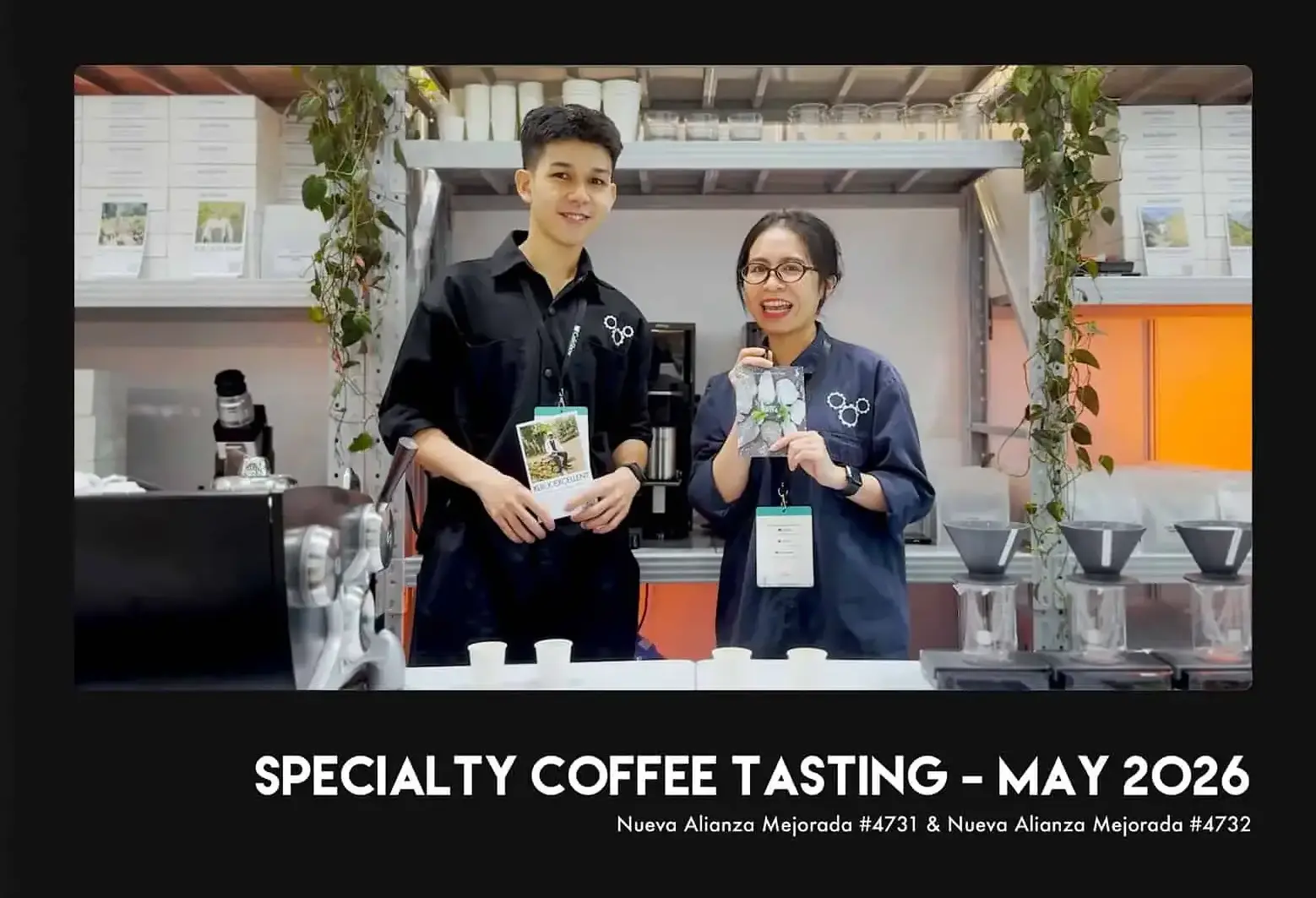
Unveiling May Discovery Subscription: Nueva Alianza Mejorada #4731 & Nueva Alianza Mejorada #4732
The Discovery Subscription is a silent dialogue, a place where the soul of the connoisseur finds a harmonious beat with distant lands. Like a transparent lens, we become storytellers, meticulously peeling back layers of cultural sediment, the breath of the soil, and the human philosophies hidden within every coffee bean.
May arrives with brilliant streaks of golden sunlight, a time when we long to hide beneath the lush, dew-drenched canopies of Santa Teresa. Amidst the silence of the Andes, when compassion touches Mother Earth, what will we hear? Perhaps it is a sweet response that nature reserves solely for souls who know how to wait patiently.

- Taste the Origin
Nueva Alianza Pacamara #4733 – The essence of Cusco with elegant jasmine notes
Nueva Alianza Pacamara #4733 is a testament to the miraculous terroir and dedicated cultivation of the renowned Cusco region. The combination of the characteristic Pacamara bean size and ideal altitude has forged a flavor profile of immense sophistication and depth. From the very first moment, this lot captivates with its elegant jasmine notes, radiating a gentle, pure fragrance akin to a flower blooming in the morning dew.

- Taste the Origin
Nueva Alianza Orange Gesha #4737 – An expedition of recessive genetic traits into the sensory realm
In a world of authenticity, Nueva Alianza Orange Gesha #4737 represents the proud emergence of rare biological traits often obscured by nature’s universality. Carrying a recessive genetic code, Lot #4737 embarks on an “expedition” into the connoisseur’s mind, where record-breaking fructose concentrations are released to perfectly fill every sensory gap with absolute smoothness and purity.
Through washed processing and extremely-light roasting, vibrant citrus nuances and ethereal floral notes, once hidden deep within the genetic structure, now manifest with power, transforming the tasting experience into a journey of ontological completion, where the rarity of recessive genes finally reigns supreme in flavor.

- Taste the Origin
Nueva Alianza Maragogipe #4735 – The “Giant” at the center of attention
Amidst a world of countless specialty coffee beans, Nueva Alianza Maragogipe #4735 emerges as a symbol of grandeur, instantly commanding attention with its distinct appearance. Affectionately dubbed the “Giant” for its impressively mutated “Elephant Bean” size, lot #4735 from Nueva Alianza stands as a testament to nature’s wonders in the Cusco region. Yet, its true allure extends far beyond its imposing exterior; hidden within these colossal beans lies a gentle “soul” blooming with pure floral and crystalline fruit notes.

Specialty Coffee in Vietnam
BRAND VALUE
YOU SHOULD HAVE KNOWN
XLIII Coffee has been aiming to become a big, impactful company with social responsibilities,
have access to high-quality raw materials and convey the complete original values of coffee to our customer
